
Know Your Pumps
Every industry today requires a pump somewhere in its operation. From food processing to oil wells, pumps play a critical role in the production and maintaining our standard of living. Pipes carry the fluid, but pumps supply the energy to move it. Because the piping and pumps work together, they must be thought of and designed as an integrated system. Change one part, and the system can become less efficient.
In this Beginner’s Guide to Pumps, we attempt to keep the Information basic and non-technical as possible. Bear in mind that pumping systems are highly technical in nature. Every length of pipe, elbow, valve, the height of the pump above or below the reservoir, fluid viscosity and inside diameters of all equipment affect the optimal discharge flow for the system.
This guide also covers the short history of pumps to see how they evolved over time. We then cover the basic parts, Types of Pumps, and the industries that use them. Lastly, we include some basic troubleshooting topics.
We hope that you find this guide useful. When it comes time to planning for a new pumping system or repairing an existing one, you can rely on the experts at All Pumps to get the job done right the first time… EVERY TIME.
How Pumps Work
Pumps are divided into two main classifications, but all work by creating a vacuum in which ambient air pressure forces the liquid. All types of pumps create areas of low pressure to start operation. In a centrifugal pump, centrifugal force accelerates the water to the outside of the impeller creating a low pressure at the eye or centre of the impeller. With reciprocating pumps, the upstroke of the plunger or piston creates a vacuum. In gear pumps or lobe pumps, as the teeth or lobes mesh then come apart, a vacuum is created. In all these types, it is the difference in pressure that creates suction. A liquid under higher pressure will move to an area of lower pressure.
Pump Pressure Terminology
- Atmospheric Pressure — At sea level, air pressure exerts a pressure of 14.7 psi all around us. By placing one end of a tube in water and applying a perfect vacuum to the other end, that 14.7 psi could hold a column of water 33.9 feet high. However, this is only attainable at sea level and with a perfect vacuum. Centrifugal pumps can lift water no more than 26 feet at sea level because the pressure drops off approximately 2 feet for each 1000 feet of altitude above sea level.
- Head — Head refers to the height at which a pump can raise a fluid and can be calculated from H (metres)= pressure in kPa/ (9.8 x specific gravity).
- Static Suction Head — The vertical distance between the centre line of a pump and the level to which the liquid is pumped.
- Suction Lift — The distance between the level of where the liquid enters the suction line to the height of the centre line of the pump when the pump is higher than the reservoir.
- Vacuum — Defined as any pressure lower than atmospheric. Each pump creates a vacuum into which fluids flow under atmospheric pressure. Pumps create low pressure or suction in a variety of ways and define the type of pump. Pumps that rotate use centrifugal force to accelerate the fluid, creating low pressure in the centre of the impeller. Positive displacement pumps use plungers, pistons or diaphragms to displace water and create a vacuum using a linear reciprocating motion of a piston moving in and out of a cylinder.
Pump Performance
Pumps have strict tolerances and precise conditions under which they must operate to generate the Best Efficiency Point or BEP. Every pump has a chart showing the performance curves and how to attain the BEP. Pump manufacturers calculate performance curves with a pressure gauge and a flow meter connected to the discharge port to find the optimal configurations of piping, type of fluid and head. The discharge capacity can be calculated for any head.
Considerations for BEP
Pump performance factors include:
- How high the pump will sit above the water source (static suction head).
- How high the discharge end is above the pump (static discharge head)
- Determine what the discharge capacity at gallons per minute (GPM).
- Friction losses to fluid viscosity, type and length of hose or pipe.
Altitude above sea level where the pump will operate. - Discharge Head or height of the discharge above the pump.
- Restrictions, couplers, elbows and valves.
As you can see, there are several forces acting upon a pump that directly affects its performance. Each force has a mathematical calculation that helps define the BEP for each pump. Consider pump performance curves from manufacturers as your mathematical cheat sheet to help you select and properly install the right pump for your application.
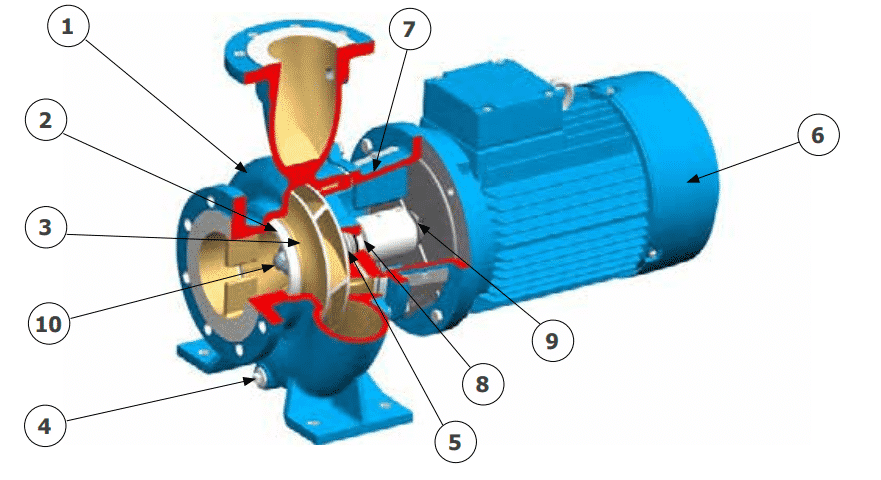
Pump Parts
- Volute Casing
- Wear Ring
- Impeller
- Screw Plug
- Mechanical Seal
- IEC StandardMotor
- Adapter
- Slinger
- Shaft
- Impeller Nut
PUMP BasicS
Although pumps come in all shapes, sizes and configurations, most pumps contain five basic components:
The Casing
this is the outer shell or housing that encases the pump and can be made from different materials depending on the duty fluid and other system requirements.
Fluid Displacement Device
this is the outer shell or housing that encases the pump and can be made from different materials depending on the duty fluid and other system requirements.
The two main ways of moving fluid are centrifugal and positive displacement. In centrifugal pumps, impellers are the rotating discs with fins or vanes attached. They spin rapidly to accelerate the fluid outwards to the discharge port. Meanwhile, positive displacement pumps use different types of pistons, gears, lobes or screws to pump fluids.
Bearings
A set of mechanical support that allows continuous rotation of the impeller, reduces the rotational friction, and supports the loads in other pump assemblies.
The Hub
The central part of a wheel attached to the bearing assembly. It is the source of power for impeller rotation in centrifugal pumps.
The Mechanical Seal
Protects the bearing assembly from excess grease loss and contamination. Seals also keep fluids inside the pump from leaking while allowing the shaft to spin or reciprocate depending upon the type of pump.
INDUSTRIES & APPLICATIONS
We find pumps in every area of our modern lives. They are important equipment needed in the manufacture of almost all essential goods we consume and use every day. From running water to the box of cereal on the table, they all require pumps as part of the process.
General industries that rely on pumps are:
Pumps by Industry
From mining to manufacturing, agriculture to wastewater, All-Pumps delivers tailored pump solutions engineered to perform across every industry sector.
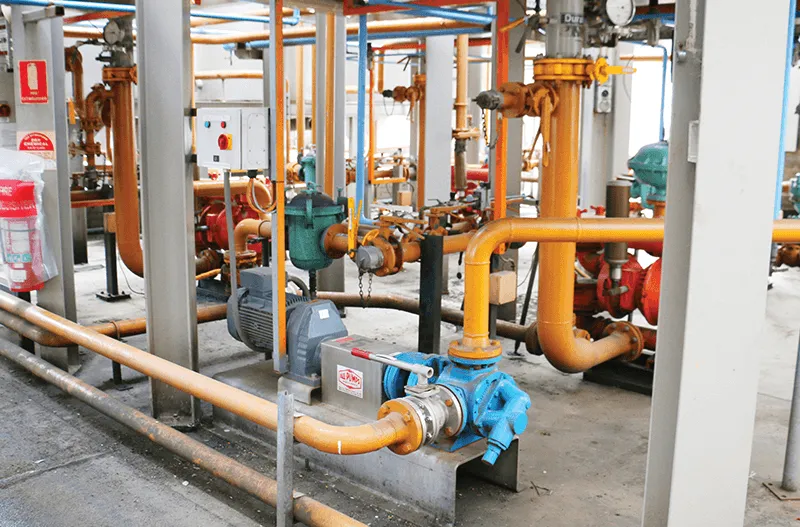
Manufacturing Pumps
We supply manufacturing businesses with everything from spare parts to custom-designed systems. With our extensive stocks and in-house expertise, we minimise downtime and keep production moving.

Mining Pumps
We provide custom-engineered pump sets and end-to-end maintenance, testing and design services for the mining industry. Our extensive range of quality products keeps your operation running smoothly.
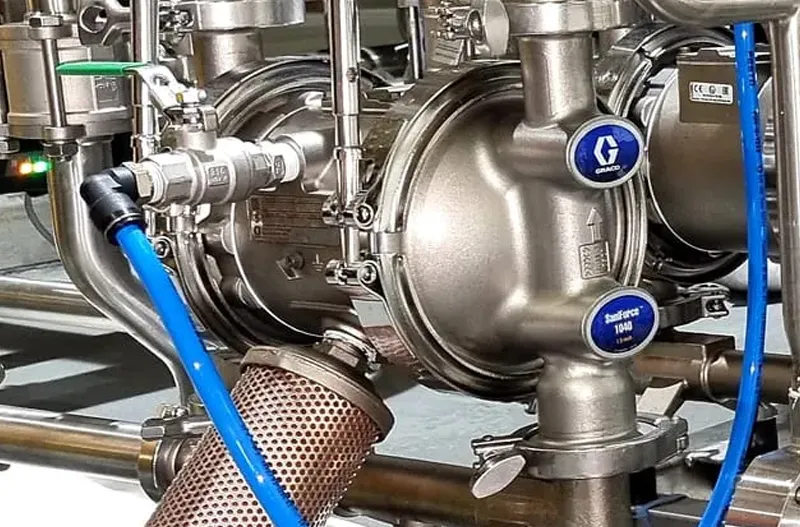
Food & Beverage
Our wide range of certified hygienic pump solutions ensures efficiency and flexibility. We help you to comply with health and safety requirements while achieving maximum returns.
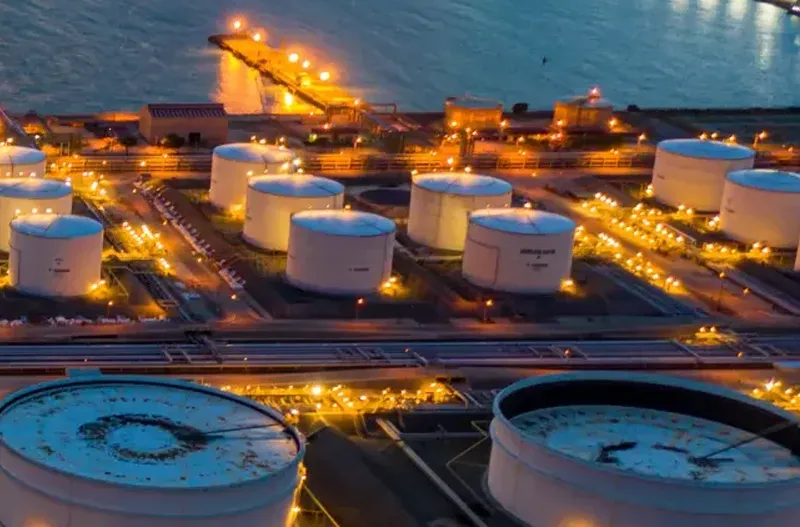
Chemical Oil Gas
We stock pumps designed for delicate & sophisticated chemical transfers. Our non-corrosive pumps can handle the harshest chemicals and raw materials, from preparation and transformation to storage.
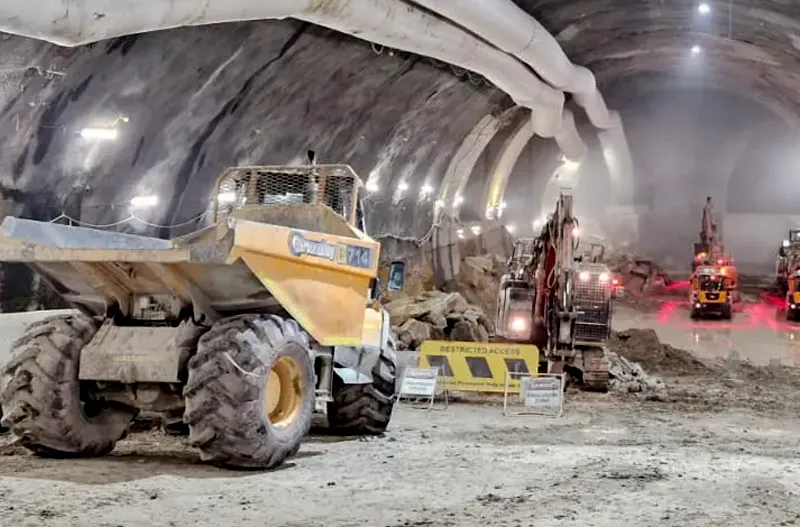
Infrastructure
Experienced in designing systems & recommending pumps for various applications. We helpcontractors operate in challenging environments with dependable, cost-effective solutions.